

Real-world data is now central to generating oncology insights and evidence, with overall survival as the field's standard endpoint. Overall survival enables researchers to evaluate treatment outcomes, inform clinical decisions, and understand the impact of new therapies.
In a clinical trial, mortality is typically tracked through a well-defined and controlled study process. In real-world care, patients may receive care from multiple providers, move between health systems, or transition between insurance plans—making mortality more difficult to capture consistently.
The challenge
No single source reliably captures mortality on its own.
Electronic health records provide rich clinical detail but may miss deaths outside the health system. Government data can be comprehensive but delayed. Obituary coverage is fragmented. Claims can provide timely, precise death information during hospitalizations but do not capture deaths outside a billing encounter.
These gaps can affect how researchers measure overall survival. If deaths are missed or recorded later than they occurred, survival estimates will be less complete or less precise. This matters most in oncology, where researchers need reliably measured outcomes across diverse patient populations and care settings.
A new peer-reviewed study, published in the Journal of Comparative Effectiveness Research, evaluates a solution to this challenge: the All-Source Composite Mortality Endpoint, or ASCME.
Bringing together multiple sources of mortality information
ASCME combines death information from four sources: patients' electronic health records, obituaries, government records, and administrative claims. It is validated against the National Death Index (NDI), the reference source for death information used in this study.
Notably, this is the first NDI-validated study of EHR-focused oncology data to incorporate claims as a mortality source and isolate its specific contribution to completeness.
The study evaluated ASCME against the matched NDI dataset across 32,358 patients spanning 10 solid-tumor datasets in ConcertAI's EHR-curated real-world datasets, sampled from a large, geographically and demographically diverse population.
Study results
| Mortality data source | Total patientsa | Sensitivity (%) | Specificity (%) | PPV (%) | NPV (%) |
|---|---|---|---|---|---|
| EHR (structured and abstracted data) | 32,358 | 75.5 (74.8, 76.1) | 98.2 (98.0, 98.4) | 97.3 (97.0, 97.6) | 82.7 (82.2, 83.2) |
| EHR + Gov't + Obituary | 32,358 | 89.8 (89.3, 90.2) | 96.8 (96.5, 97.1) | 95.9 (95.6, 96.2) | 91.9 (91.5, 92.2) |
| ASCME: EHR + Gov't + Obituary + Claims | 32,358 | 95.0 (94.6, 95.3) | 96.5 (96.2, 96.7) | 95.8 (95.4, 96.1) | 95.8 (95.5, 96.1) |
a 14,241 patients with a matched NDI date of death.
ASCME = All-Source Composite Mortality Endpoint; EHR = electronic health record; NDI = National Death Index; NPV = negative predictive value; PPV = positive predictive value.
The addition of claims as a source of death information reduced the missingness of death records by more than half and contributed an incremental 5.2% gain in sensitivity, driving overall sensitivity to 95.0%. Overall specificity was 96.5%, with positive and negative predictive values of 95.8% each.
Among patients identified as deceased in both datasets, 97.9% had death dates within five days of one another—the closest proximity to a reference death date examined for oncology real-world data.
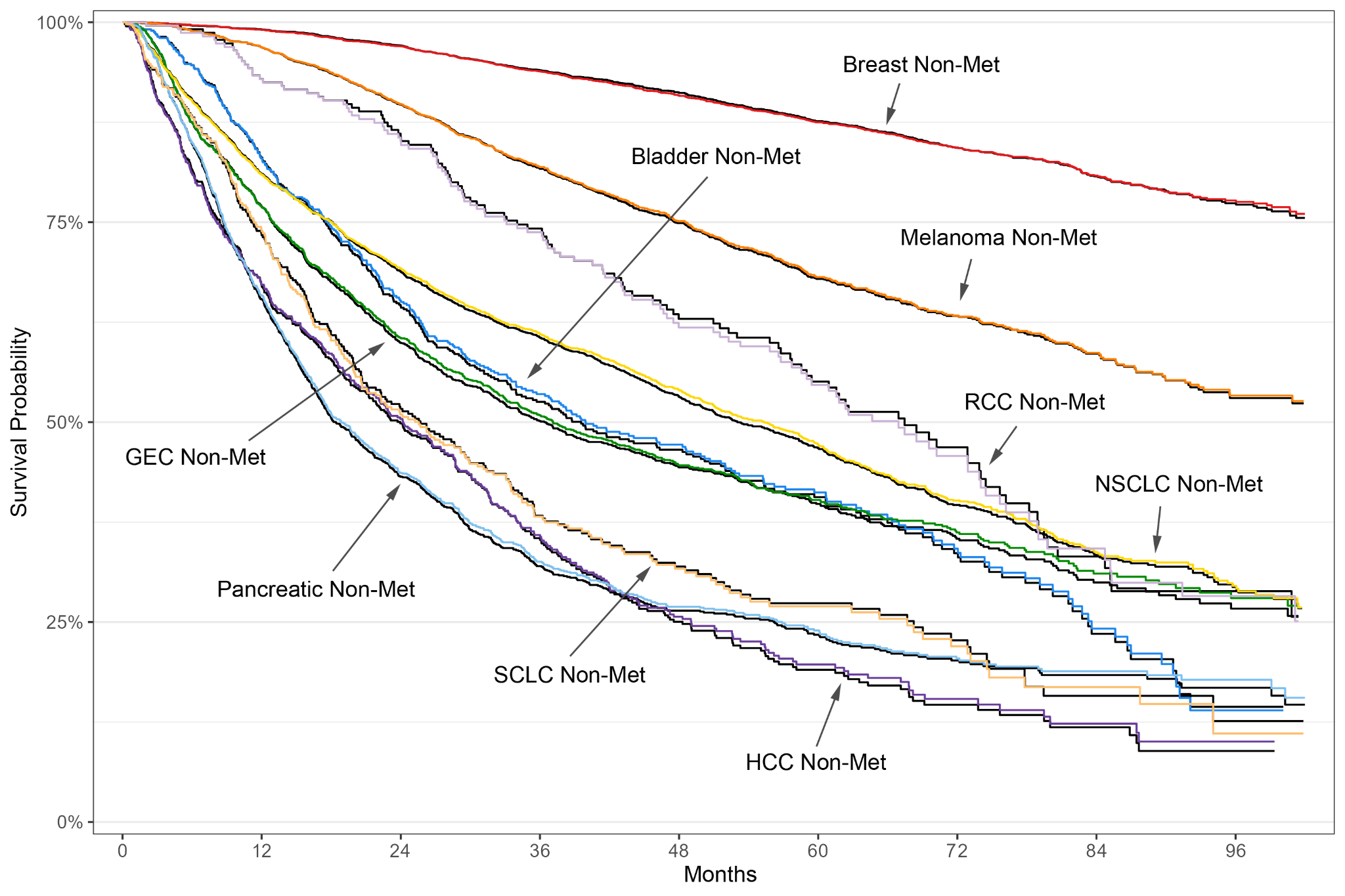
Overall survival estimates using ASCME were closely aligned with those based on the NDI. Median overall survival differed by only 12.2 days in non-metastatic cohorts and 4.5 days in metastatic cohorts—results that were largely indistinguishable from NDI-based estimates across both populations in all tumors examined.
Research perspective
“This validation study demonstrates the value of combining complementary data sources to create a more complete and reliable understanding of patient outcomes. For researchers working across oncology, confidence in mortality data is essential to generating meaningful real-world evidence.”
Why this matters for oncology research
Real-world evidence is increasingly important for understanding how patients experience cancer outside the highly selected environment of a clinical trial. It can help researchers evaluate treatment patterns, outcomes, and unmet needs across broader patient populations and care settings.
Reliable mortality data is foundational to that work.
When death information is more complete and accurately dated, researchers can have greater confidence in survival analyses. This supports evidence generation across clinical development, comparative effectiveness research, post-approval studies, and health outcomes research.
The study also highlights the value of combining complementary data sources. No single source captures every patient outcome perfectly. Together, multiple sources—particularly with claims closing more than half the gap in missed deaths—can help improve the quality of real-world oncology data.
Advancing confidence in real-world outcomes
At ConcertAI, we believe real-world data should do more than describe healthcare—it should help answer the questions that matter most to patients, clinicians, researchers, and life sciences organizations.
Validating ASCME against the National Death Index is an important step in demonstrating the reliability of mortality information captured within our real-world datasets. It reinforces ConcertAI's broader commitment to developing and validating the measures that make real-world evidence more reliable and actionable.
As oncology continues to evolve, the ability to measure survival accurately across diverse populations and care settings will become even more important. High-quality mortality data can help ensure that real-world evidence reflects the experiences of patients in everyday care—and supports the decisions that shape the future of cancer treatment.
Want to dig deeper? Explore the research.