

Today, it is apparent that the rapid progress of AI is prompting intense debate—including among frontier labs—about the risks of recursive learning, particularly given our still-limited guardrails for fully controlling this technology.
The potential of a technology is not inherently the problem. What matters is how humans choose to use and govern it.
There are few areas where realizing the full potential of AI is as inspiring and desirable as its application in oncology.
Despite substantial progress in the pre-AI era, cancer remains the second-leading cause of death worldwide. Last year, one in five people died from cancer. Next year, by and large, that statistic will likely still hold.
But many believe that advances in biological discovery, combined with technological innovation, are moving us closer to a day when that will no longer be the case.
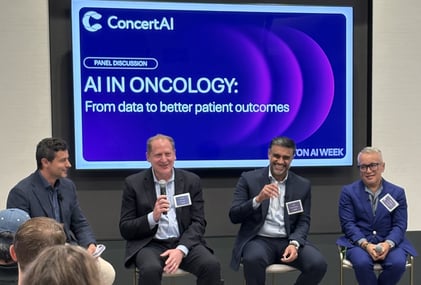
To assess both the opportunities and the guardrails surrounding AI in oncology, ConcertAI hosted a Boston AI Week panel that generated an excellent debate among an outspoken group of panelists.
Several key themes emerged, many of which exemplify the operating principles behind everything we do at ConcertAI. These included the importance of data and its quality; the impact of AI on decisions made in the lab and at the patient’s bedside; and the imperative to improve and tailor communication with patients.
Everything starts with the tedious and often understated process of building high-quality data foundations—particularly real-world data—for AI to use.
AI is already informing major decisions across the life sciences. Not all decisions are published, but the progress of multimodal data derived from actual human subjects has already led to many futile trials being stopped before they begin, trial designs being changed, and new programs being accelerated.
Many in the field discuss the ultimate vision of creating virtual representations of patients and their diseases—often referred to as “digital twins”—to enable smaller trials and make clinical research as human-independent as possible. While there is still a long way to go before reaching that North Star, primarily because of data availability, there are lower-hanging opportunities short of the digital-twin concept that are already transformational.
AI can generate highly effective ways to communicate in lay terms or through illustrations with a cancer patient who has been shocked by a diagnosis and wants to understand their options without being overwhelmed by complex diagnostics, genomics, and scientific terminology.
Across all these areas, AI is making substantial progress.
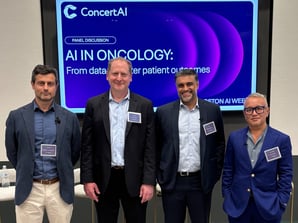
Special thanks to Siddarth S. , Dr. Don S. Dizon , and our own Mike Rossi and Claudio D‘Ambrosio for an engaging and insightful panel discussion—and for sharing their passion for advancing progress in the complex world of oncology.
This session would not have been possible without the Greenough Communications team. Thank you for collaborating, hosting, and bringing this idea to the table.